
Table of Contents
- Introduction
- Business Context and Problem Definition
- Core Processes
3.1. Category Management Application
3.2. Attribute Management Application
3.3. Material Assignment Application
3.4. UI Configuration Application
3.5 Outstanding Features - Modelling Overview and Architecture
1. Introduction
A taxonomy is a general term for a classification scheme. The purpose of a taxonomy is to group like things together into categories, usually based on a set of common, category-specific characteristics, or attributes. This article introduces the medepia Taxonomy Management, which is an enterprise application designed to standardize and organize the management of product categories and their associated attributes across large organizations. Built on the SAP ecosystem and leveraging technologies such as Master Data Governance (MDG), ABAP RAP (RESTful Application Programming), and Fiori, this system provides full control and flexibility over classifying products and their characteristics, enabling efficient product data management across the organizational systems and channels.
Medepia Taxonomy Governance App
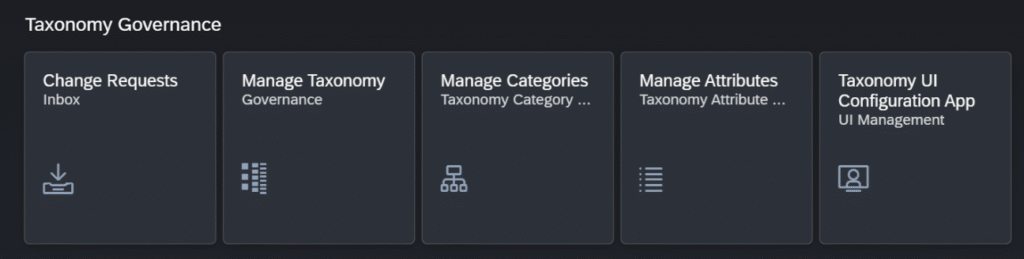
Figure 1 – medepia Taxonomy Governance Application
Manage Categories
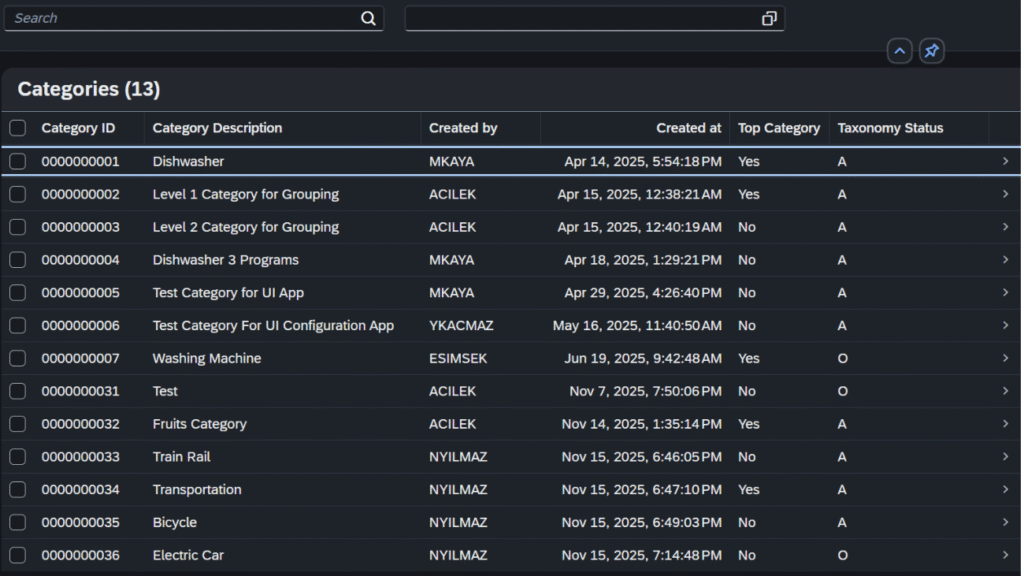
Figure 2 – Manage Categories
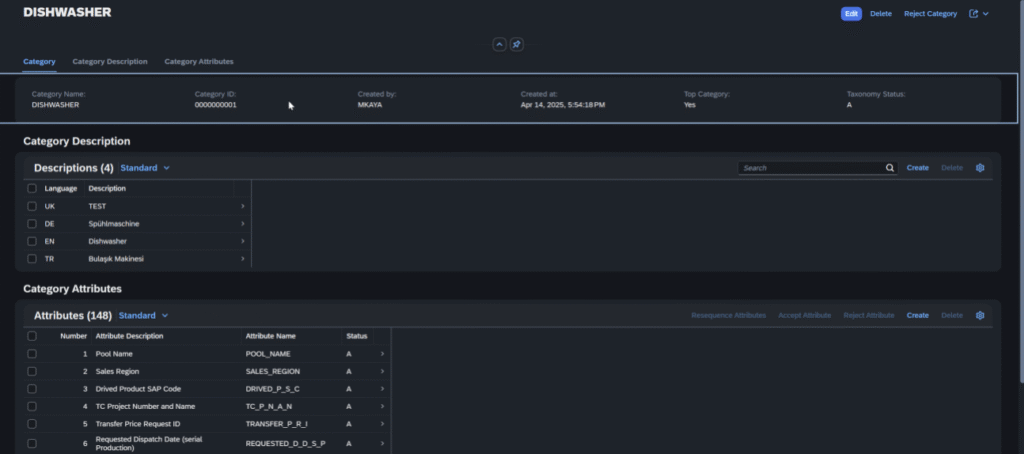
Figure 3 – Category details: Dishwasher
Manage Attributes
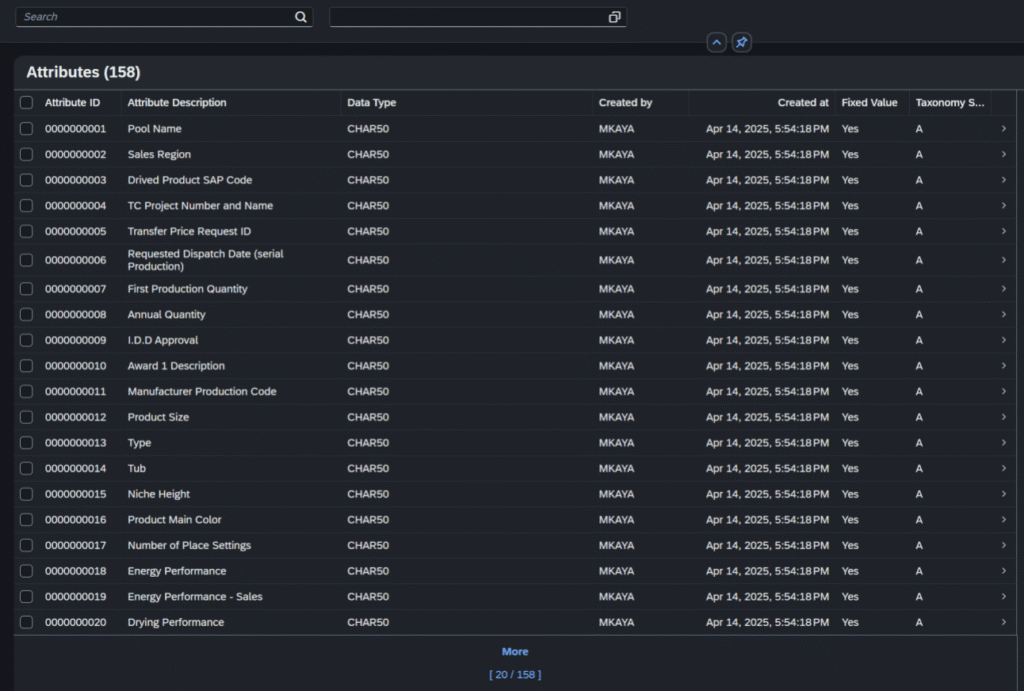
Figure 4 – Managing Attributes of the taxonomy
2. Business Context and Problem Definition
In today’s digital business landscape, organizations manage thousands of products across multiple systems like ERP and e-commerce platforms. Each system often defines its own product categories and attributes, sometimes leading to inconsistent product data. This inconsistency makes it difficult to maintain accurate product information, integrate systems, and ensure unified customer experience. Custom Applications created to solve this problem slow down operations by requiring technical changes whenever a new attribute or category is added.
To remain competitive, businesses require a governed, dynamic, and scalable taxonomy application that centralizes the management of product categories and attributes while also ensuring multilingual and hierarchical consistency, integrating seamlessly with SAP’s MDG and RAP environments for robust master data governance. medepia Taxonomy Management directly addresses these needs by providing an easily configurable, unified and intelligent approach to organizing, maintaining, and governing product data within the SAP ecosystem that improves data quality across the enterprise, without any need of backend code or database schema changes.
3. Core Processes
The medepia Taxonomy Application is built around five core processes: creating attributes, creating categories, linking attributes to categories, and assigning materials to these categories while capturing all related product data. Together, these processes form a modular governance framework, allowing product information to be structured, enriched, and maintained consistently across the SAP landscape.
These processes are each executed in separate but interconnected applications.
- Attributes and their category bindings can be created in Attribute Management,
- Categories and attribute bindings are created in Category Management,
- Assignment of categories to materials can be made through SAP MDG Change Requests.
By this separation of processes and the material-level data entry, the application ensures flexibility and clear ownership of each step.
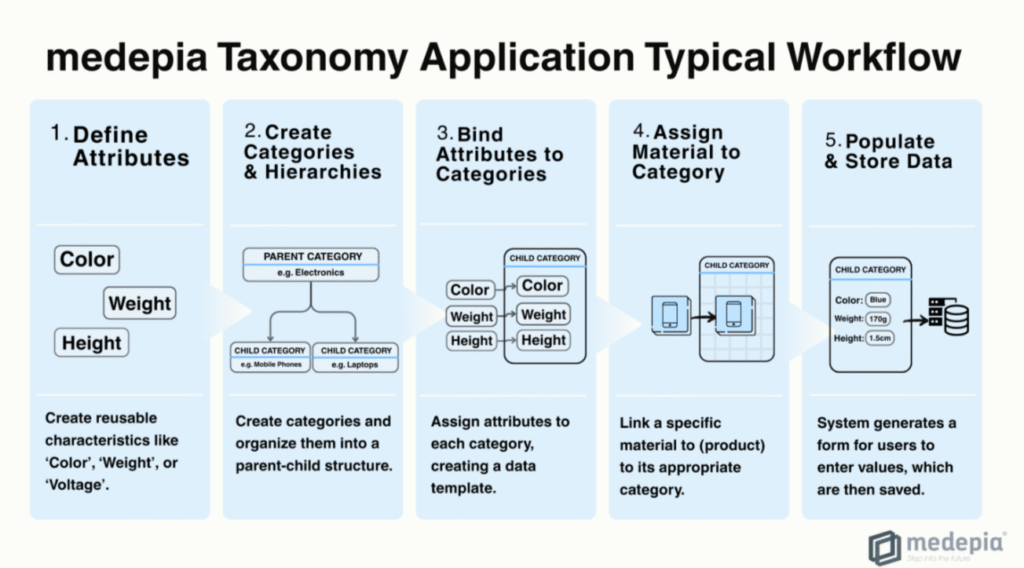
Figure 5 – medepia taxonomy workflow
3.1. Category Management Application
A structured environment for creating and managing product categories and their hierarchical relationships. Each category passes through well-defined stages to validate eligibility of the data. Each category can have its own set of attributes with configurable UI layouts and field properties.
The taxonomy supports a fully hierarchical structure of product categories where each node can inherit attributes and properties from its parent. This feature reduces redundancy and ensures consistent attribute coverage across related product families.
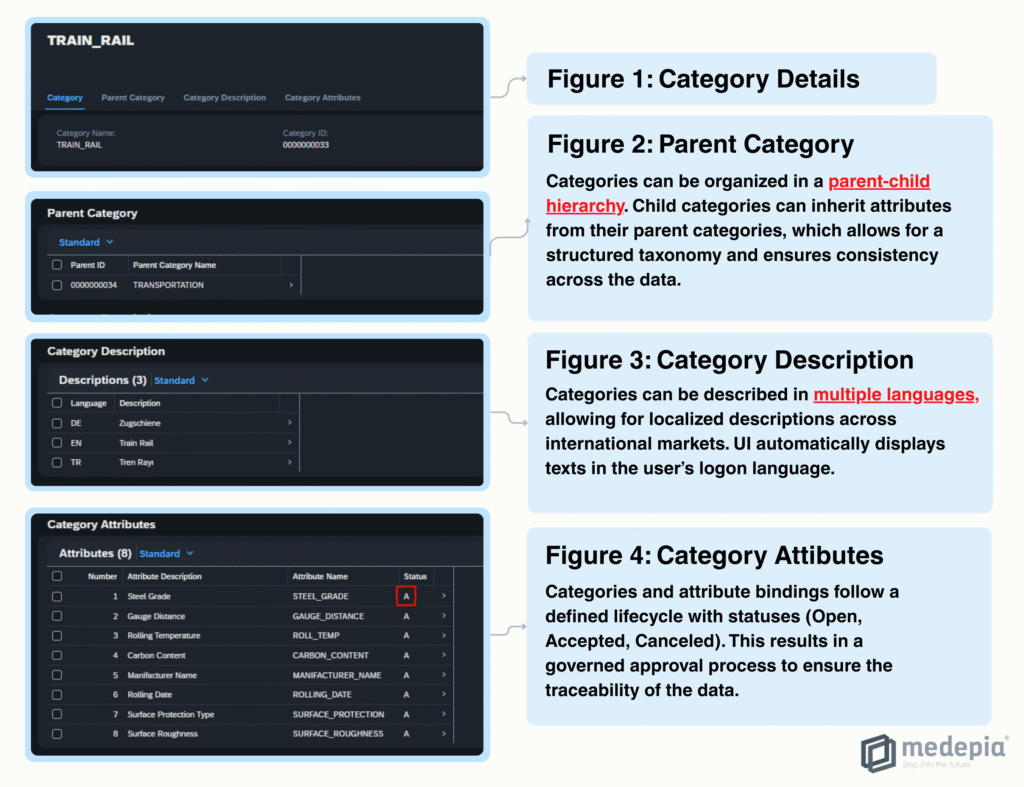
Figure 6 – Category Management
3.2. Attribute Management Application
Attributes are entities for any product characteristic such as color, weight, height, or voltage etc. that can be assigned to product categories which they are related to. Attribute management governs how product characteristics are defined, validated, and applied to categories. Attributes support configurations including data type, length, value help and multilingual descriptions.
Attributes can be bound to more than one category, and their binding is governed by lifecycle statuses which are Open (O), Accepted (A), Rejected (R). If the attribute has default values that should be selected from a list in the UI, user can define attribute value helps in Attribute Management Application.
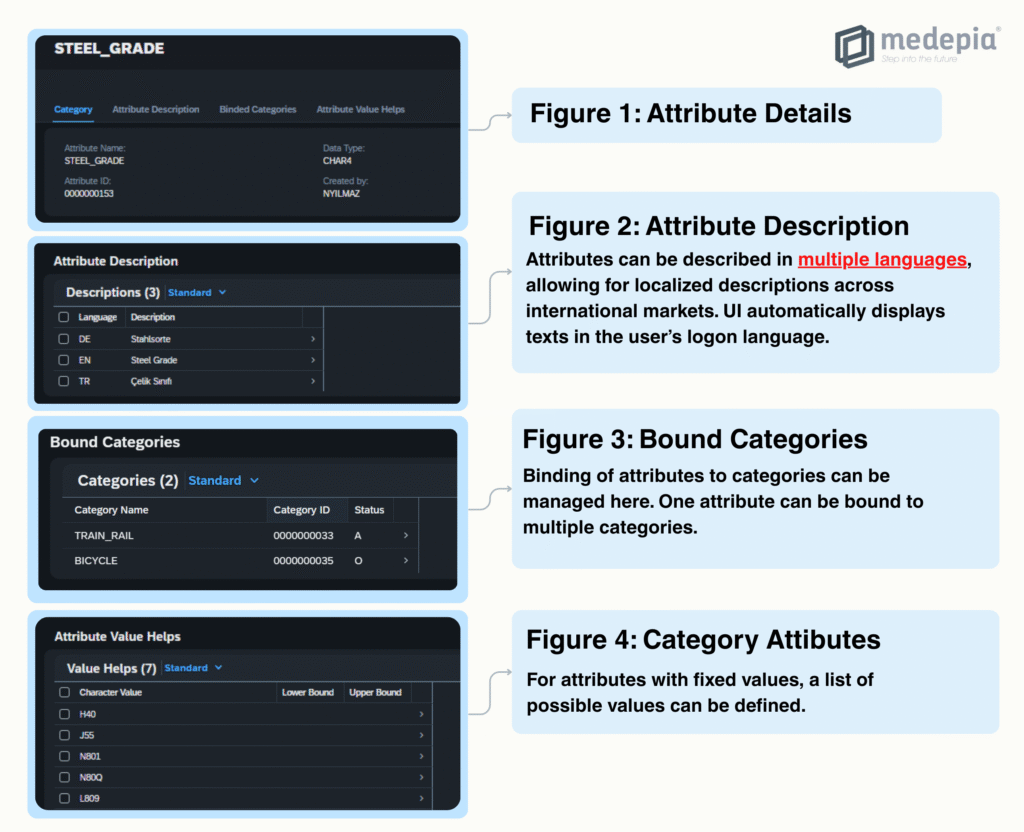
Figure 7 – Attribute Management
3.3. Material Assignment Application
This application enables assigning SAP materials to taxonomy categories and maintaining corresponding attribute values dynamically via SAP MDG change requests. User can select a material, Assign the material to one of the categories, and then fill in the values of the attributes bound to the assigned category.
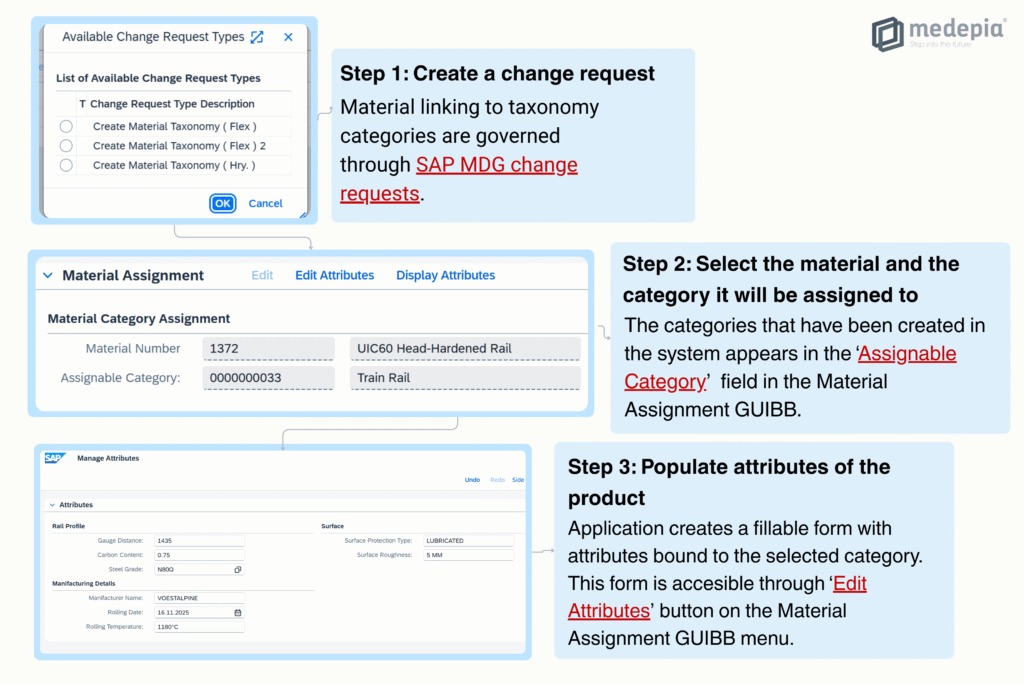
Figure 8 – Assign taxonomy to material
3.4. Taxonomy UI Configuration Application
Supporting these core processes and applications, there is Taxonomy UI Configuration application, a runtime component that generates user interface fields (Groups) that enables organized presentation of category attributes without needing any more technical deployment. Relevant attributes can be grouped together, and both the groups and the attributes inside can be positioned depending on different scenarios, resulting in a more intuitive and easier-to-use UI.
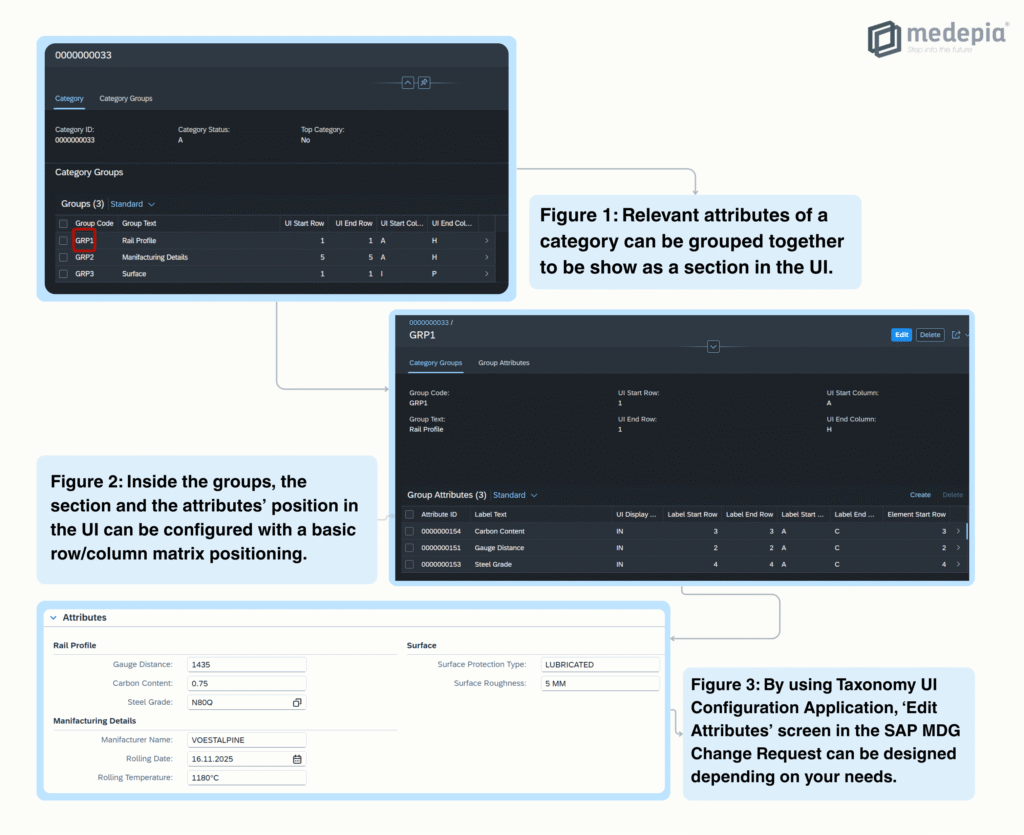
Figure 9 – UI Configuration
3.5. Outstanding Features
Throughout the workflow, different features, capabilities and intelligent approaches makes the application governed, dynamic, and scalable. Some of these features are;
- Dynamic Attribute Management that allows the system to create and manage product attributes at runtime based on metadata rather than hard-coded logic. New fields can be introduced instantly without altering database structures or redeploying applications, which enables rapid attribute creation and governance, improving agility.
- JSON-based persistence which enables flexible storage of multiple attribute types.
- Value helps for predefined lists and numeric ranges speed up the assignment processes.
- Hierarchy and Inheritance that allows for automatic propagation of attributes to child categories when connected via parent-child relationships.
- Status Governance which allows the Categories, Attributes and Attribute to Category bindings to follow a defined lifecycle with statuses (Open, Accepted, Canceled). This governed approval process ensures data accuracy and traceability.
Multilingual Support, enabling both categories and attributes to be described in multiple languages to support global product catalogs. UI automatically displays texts in the user’s logon language.
4. Modelling Overview and Architecture
The medepia Taxonomy Management application follows a four layered architecture, built on top of the SAP ecosystem, combining user interface, service, business logic, and database layers into a cohesive framework. Each layer communicates through well-defined data models and interfaces based on SAP Core Data Services (CDS) and RAP behavior definitions. This modelling approach provides speed, scalability, and maintainability across the entire taxonomy lifecycle.
| User Interface Layer (UI) | Built using SAP Fiori and FPM frameworks. Maintains applications for category, attribute and material management. |
| Service Layer | Implements OData services that expose CDS based entities for the access and validation of data to interact with UI. |
| Application Layer | Contains ABAP classes and RAP behavior handlers for dynamic field generation, inheritance logic, and governance workflows. Consists of enhancement points (BadIs) and BRF+ rules. |
| Persistence Layer (Database) | A normalized data foundation that stores all taxonomy entities such as attributes, categories, hierarchies, relationships, and material classification data in a structured model using database tables. |
 English
  Turkish
  German